
GuidelinesBy procedure2026.11.02
Veterinary Medical Device Classification and Application Route — A Table for Checking Notice Designation, Class and Class 1 Substantial Equivalence in One Flow
A product an overseas manufacturer calls ‘pet care equipment’ may still be a veterinary medical device in Korea depending on its intended use. Whether a product is a veterinary medical device is decided by the items designated by notice, its class by the Annex 8 criteria, and the notification or approval route for Class 1 by substantial equivalence. This guide sets out an intended-use review table, a four-step decision flow, a Class 1 equivalence comparison table and the APQA procedure for requesting an applicability review.
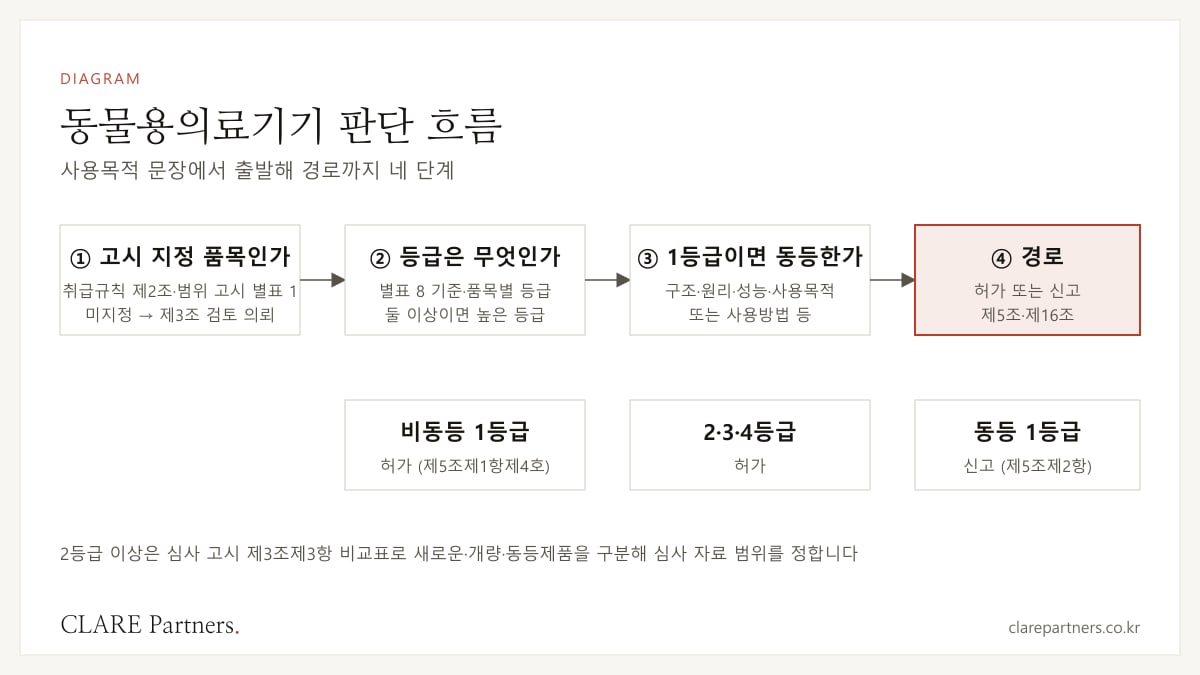
Key takeaway — There are four steps, in order. (1) Is it a medical device intended for animal use and an item designated in the notice? (2) What is its class under the Annex 8 criteria and the item-by-item class in Annex 1 of the Scope Notice? (3) If it is Class 1, is it substantially equivalent to an item already approved or notified? (4) So is it the approval route or the notification route? Start from the intended-use sentence, not the product name or an overseas classification.
This article is based on the Rules on the Handling of Veterinary Pharmaceuticals, etc. (MAFRA Ordinance No. 741, in force 31 October 2025), and the APQA notices Regulation on the Scope and Classification of Veterinary Medical Devices (No. 2021-36), Regulation on the Approval, etc. of Veterinary Medical Devices (No. 2020-19) and Regulation on the Review of Technical Documents, etc. for Veterinary Medical Devices (No. 2020-18), as checked on 6 October 2026. The overall framework of jurisdiction and structure is in the veterinary medical device registration guide.
Step 1: Write the intended-use sentence first
Article 2(1)(iv) of the Handling Rules defines a veterinary medical device as a medical device intended for animal use that the APQA Commissioner determines and designates by notice in consultation with the head of the National Fisheries Products Quality Management Service. Point (iv-2) separately defines veterinary in vitro diagnostic medical devices in the same way. The first question is therefore not the class but two things: is the intended use a purpose that qualifies as a medical device, and is the item designated in the notice?
Do not lump the intended use together as ‘animal health management’. Write in one sentence the target animal, the site of application, the function performed, and how the result is used in clinical judgement. Read the manufacturer's instructions, specifications and website description together and extract the purpose they all confirm, keeping the sources on record so that domestic marketing copy does not run ahead of the functions the manufacturer has substantiated.
| Item | Manufacturer's description | Wording intended for Korea | Supporting document | Open question |
|---|---|---|---|---|
| Intended use | Sentence as written in the instructions | Draft advertising and instructions | Page of the instructions | Do the two wordings describe the same function? |
| Operating principle | Sensor, energy, physical action | Same | Specification | Measurement or display? |
| Site of application, target animal | Species, site | Same | Instructions | Invasive or contacting? |
| Performance | Figures, ranges | Same | Test data | Basis for claimed performance |
| Components | Main unit, consumables, software | Sales configuration | Component list | Are there parts to classify separately? |
This table is our own proposal for an initial review and is not a statutory form. As a fictional example, Sensor A, which displays activity during walks, and Sensor B, which measures a specific vital sign to support a veterinarian's clinical judgement, differ in intended use, measurement function and displayed result even if they look alike. The example does not conclude that A is a non-medical device and B is a particular class; it means the two products raise different questions.
Step 2: Compare against notice-designated items and classes
Article 2(1) of the Scope Notice sets the scope and classification of veterinary medical devices in Annex 1. Annex 1 lists items in the format of code, item name, class, English name and description. Paragraph (2) of the same article provides that a part manufactured and sold independently, whose main function is to deliver performance and achieve the intended use, may be classified as a separate item, and paragraph (3) provides that where two or more devices are combined and used as a separate device, the whole may be classified as one.
The class criteria are in Annex 8 of the Handling Rules. The APQA Commissioner classifies devices into four classes according to the intended use and the degree of potential hazard to the animal and the handler during use, and where a device falls within two or more classes it is classified in the class of the highest risk. The criteria for judging hazard are the duration of contact with the animal, the degree of invasiveness, and whether the device delivers veterinary pharmaceuticals or energy, etc.
| Class | Annex 8 criteria |
|---|---|
| Class 1 | Devices that do not come into direct contact with the animal or the handler, or whose potential hazard is minimal even on contact, and whose failure or malfunction has only minor effects |
| Class 2 | Devices that carry a risk from failure or malfunction but have a low likelihood of leading to danger to life or serious functional impairment, so that the potential hazard is low |
| Class 3 | Devices inserted into the animal for a certain period of use, or devices with a high potential hazard |
| Class 4 | Devices used in direct contact with the heart, central nervous system or central circulatory system, etc.; devices using animal tissue or extracts, or raw materials with insufficient verification information on safety, etc.; devices with a high degree of hazard |
In practice, find the item code and class in Annex 1 and confirm that its description matches your product's intended use. If the item name does not match the list, it is entered under Article 9(i) of the Approval Notice according to the result of the review under Article 3(5) of the same notice. Annex 8, point 4, provides that the class of an item may be reclassified on the application of an interested party or where necessary, and that an application is to be reviewed, decided and notified within 60 days.
If applicability itself is uncertain, there is the procedure in Article 3 of the Scope Notice. If you request a review from the APQA Commissioner with data on the intended use, data on the shape, structure, raw materials, performance and method of use, and data on the operating principle and specifications, etc., the APQA Commissioner reviews whether the product qualifies as a veterinary medical device and whether item designation is possible, etc., and notifies the result within 7 days. This is a formal procedure based on the notice, not a consultation desk.
Step 3: If Class 1, confirm substantial equivalence
Article 5(1) of the Handling Rules designates as subject to approval Classes 2, 3 and 4, and those Class 1 veterinary medical devices that are not substantially equivalent in structure, principle, performance, intended use or method of use, etc. to an item already approved or notified. Paragraph (2) designates as subject to notification substantially equivalent Class 1 items. For imports, Article 16 applies the same distinction mutatis mutandis.
The enumeration in the provision is ‘structure, principle, performance, intended use or method of use, etc.’. Use it as the comparison items as written, without altering the middle dots and the ‘or’. Having found an item to compare against does not in itself demonstrate equivalence.
| Comparison item | Product being introduced | Existing approved or notified item | Difference | Evidence |
|---|---|---|---|---|
| Structure | Drawings, photographs | |||
| Principle | Instructions | |||
| Performance | Specifications, test data | |||
| Intended use | Approved or notified intended use | |||
| Method of use | Instructions | |||
| Other (raw materials, contact conditions, etc.) | List of raw materials |
Leave characteristics that cannot be learned from the public information on the existing item as ‘unconfirmed’, and record the source of the comparison data, because the wording on a sales page may differ from the intended use actually approved or notified. Distinguish the fact that a difference exists from the final judgement that the items are not substantially equivalent. Hand items where judgement remains over to obtaining manufacturer data or confirming with APQA.
Different provisions apply to Class 2 and above. Article 3(3) of the Review Notice provides that Class 2 and above are reviewed by distinguishing new products, improved products and equivalent products according to the equivalent product criteria in Annex 3, using the substantially equivalent item comparison table in Annex 4, and Article 6(3) provides that submission of review data may be waived according to that distinction. Class 1 equivalence is the fork between notification and approval; equivalence for Class 2 and above is the fork in the scope of review data.
Step 4: Fix the route and set the scope of documents
| Situation | Route | Basis | Preparation that follows |
|---|---|---|---|
| Class 2, 3 or 4 | Approval | Article 5(1)(iii), Article 16(1)(ii) | Technical documents, safety and effectiveness data, test report, certificates of manufacture and sale |
| Class 1, not substantially equivalent | Approval | Article 5(1)(iv) | As above |
| Class 1, substantially equivalent | Notification | Article 5(2)(ii), Article 16(2)(ii) | Product information documents, certificates of manufacture and sale or documents that can prove the same |
| Does not match a notice item name | Review request under Article 3 of the Scope Notice, or a mid-category name or separate item name under Article 3(5) of the Approval Notice | Article 2(1)(iv), Article 3 of the Scope Notice, Article 9 of the Approval Notice | Item name and class entered according to the review result. If the result is that the product does not qualify as a veterinary medical device, check separately whether other legislation applies |
Only once the route is fixed can the scope and schedule for preparing test data, certificates of manufacture and sale, and technical documents be fixed. Even on the notification route, the product information under Article 5(3)(ii)(a) (item name and model name, classification number and class, shape and structure, raw materials, manufacturing method, performance and intended use, method of use, packaging unit, storage method and shelf life, precautions, test specifications, manufacturing source, etc.) must be prepared. Article 3(1) of the Approval Notice provides that products in the same product group may be applied for under one approval or notification, so review the model configuration as well.
Common misunderstandings
| Common explanation | What the provisions provide | What to check |
|---|---|---|
| It is low risk overseas, so it is Class 1 in Korea | The class is determined by the Annex 8 criteria and the class of each notice item. | Annex 1 item code and class |
| Class 1 means notification | Class 1 items that are not substantially equivalent are subject to approval. | Difference items in the comparison table |
| We use the human-use classification number as is | Veterinary devices have a separate notice system. | Annex 1 of the Scope Notice |
| A set product takes the lower class | Combined and multi-component devices take the class of the highest risk. | Class of each component device |
| If it is not on the list, we cannot apply | There are provisions for entering the item name according to a review result and for using a mid-category or separate item name. | Article 3(5) and Article 9 of the Approval Notice |
How to decide whether a human-use product is a medical device is in how to check whether your product is a medical device. Veterinary devices have a different notice system, so the item codes in that article are not used as they are.
Documents that speed up the review if prepared before enquiring
- The manufacturer's original instructions and specifications, product photographs and model name
- A draft of the intended use to be described in Korea and the advertising draft
- Information on the existing item to be compared against and a note of the differences
- Sales configuration (main unit, consumables, software)
Please mention veterinary medical devices in your message when you use the preliminary veterinary item review request. We will set out the questions to confirm on applicability, item and class, and Class 1 equivalence, and advise on the order of import preparation. Agency fees are quoted separately according to the item and the scope of documents. The scope of services is on the veterinary medical device services page.
Prepared and sources checked: 2026-10-06. Sources: Rules on the Handling of Veterinary Pharmaceuticals, etc. Article 2(1)(iv) and (iv-2), Article 5(1), (2), (3) and (6), Article 16, Annex 8 · Regulation on the Scope and Classification of Veterinary Medical Devices (Notice No. 2021-36) Articles 2 and 3, Annex 1 · Regulation on the Approval, etc. of Veterinary Medical Devices (Notice No. 2020-19) Articles 3 and 9 · Regulation on the Review of Technical Documents, etc. for Veterinary Medical Devices (Notice No. 2020-18) Article 3(3), Article 6(3). The review table, comparison table and fictional example are our own practical tools and are not a classification conclusion for an individual product.
Frequently asked questions
- Q. If the manufacturer says it is not a medical device, is it not a medical device in Korea either?
- No. Under Article 2(1)(iv) of the Handling Rules, a veterinary medical device is a medical device intended for animal use that the APQA Commissioner designates by notice. The decision rests on the intended use in Korea and the items designated by notice, not on an overseas classification or the manufacturer's description. If the decision is difficult, you can ask the APQA Commissioner for an applicability review under Article 3 of the Scope Notice.
- Q. If it is Class 1, is notification enough?
- Article 5(1)(iv) of the Handling Rules designates as subject to approval those Class 1 veterinary medical devices that are not substantially equivalent in structure, principle, performance, intended use or method of use, etc. to an item already approved or notified. Only substantially equivalent Class 1 items are subject to notification under Article 5(2)(ii). The route is not decided by the class number alone.
- Q. What if the item is not on the notice list?
- Article 9 of the Approval Notice provides that where the item name does not match the Scope Notice, it is entered according to the result of a review under Article 3(5) of the Approval Notice. The same paragraph provides that for products whose classification takes time, such as newly developed veterinary medical devices, a mid-category name or a separately determined item name may be used, in which case the classification criteria in Article 5(6) of the Handling Rules apply.
- Q. Which class does a set combining two devices fall into?
- Article 3(2) and (3) of the Approval Notice provide that where the classes of a combined veterinary medical device or a multi-component veterinary medical device differ, it is classified in the class of the highest risk. Annex 8 also provides that where a device falls within two or more classes, it is classified in the class of the highest risk.